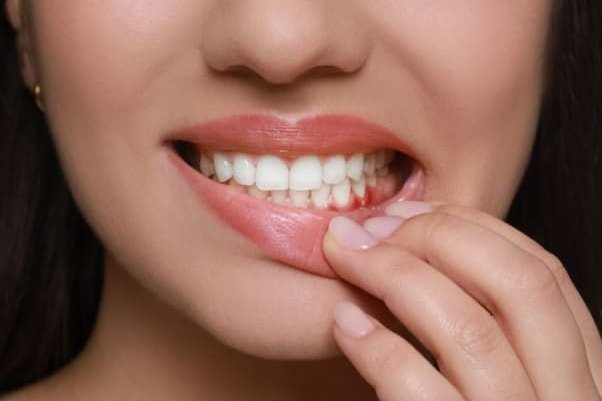
That sudden, sharp twinge when you sip cold water, bite into ice cream or breathe in cold air is called dentine hypersensitivity. It is one of the most common reasons people visit a dentist, and in most cases it can be calmed down or fixed completely.
The short answer
Teeth become sensitive when the softer layer under the enamel, called dentine, is exposed. Dentine has thousands of tiny channels that lead to the nerve, so cold, heat, sweet or sour foods reach the nerve quickly. A desensitising toothpaste helps most people within two to four weeks. If one tooth hurts sharply, or the pain lingers for more than a few seconds, see a dentist, because it may be a cavity, a crack or an irritated nerve rather than simple sensitivity.
Common causes
- Gum recession: when gums pull back, the root surface is exposed. Roots have no enamel, so they feel cold quickly.
- Brushing too hard or with a hard-bristled brush, which wears enamel and pushes gums back.
- Acidic food and drink: citrus, soft drinks, sports drinks, pickles and frequent lemon water soften enamel over time.
- Teeth grinding, which flattens and thins the enamel.
- A cavity, cracked tooth or worn filling, which lets cold reach the nerve at one spot.
- After dental treatment: a new filling, cleaning or whitening can leave teeth sensitive for a few days. This usually settles on its own.
Sensitivity or something more serious?
A useful rule is to notice how long the pain lasts.
- A short, sharp zing that stops within a few seconds once the cold is gone is typical sensitivity.
- Pain that lingers for 30 seconds or more, throbs on its own, or wakes you at night suggests the nerve itself is inflamed. That needs an examination, and sometimes a root canal.
- Pain when you bite on one tooth can mean a crack.
What you can do at home
- Switch to a desensitising toothpaste containing potassium nitrate, stannous fluoride or arginine, and use it twice a day for at least two weeks.
- After brushing, spit but don't rinse, so the active ingredient stays on the teeth longer.
- You can also rub a small amount of the toothpaste onto the sensitive area at night.
- Use a soft brush and gentle, small circular strokes instead of hard scrubbing.
- After acidic food or drink, rinse with water and wait about 30 minutes before brushing, because softened enamel wears more easily.
How a dentist treats sensitive teeth
- Fluoride varnish or desensitising agents painted onto the exposed areas to seal the tiny channels.
- Bonding a thin layer of tooth-coloured filling over exposed roots or worn spots.
- Replacing a leaking filling or treating a cavity.
- A night guard if grinding is wearing the enamel.
- Gum treatment or a gum graft for significant recession.
- Root canal treatment, only when the nerve is damaged and nothing else works.
Frequently asked questions
Does sensitivity mean I have a cavity?
Not always. General sensitivity across several teeth is usually exposed dentine. Sensitivity in one spot that keeps getting worse is more likely a cavity or a crack, so it's worth getting checked.
How long does desensitising toothpaste take to work?
Many people notice a difference within a week, and full effect usually takes two to four weeks of twice-daily use. It needs to be used regularly, because the effect fades if you stop.
Can teeth whitening cause sensitivity?
Yes, temporarily. It normally settles within a few days. Our page on teeth whitening explains how in-clinic whitening keeps this to a minimum.
Is sensitivity permanent?
Usually not. Once the cause is treated and the dentine is sealed, most people can enjoy cold food and drink again.
Sensitivity often goes hand in hand with gum problems; our guide to bleeding gums explains the early signs.
Book a consultation in GK-1
If a sensitive tooth is getting worse, a quick examination will tell you why. Ark Dental Global is at R-27, 1st Floor, Greater Kailash-1, New Delhi 110048, a short drive from GK-2, CR Park, Kalkaji, Lajpat Nagar and Saket. We are open Monday to Saturday, 10 AM to 8 PM. Call or WhatsApp +91 99905 09300, or book online.